





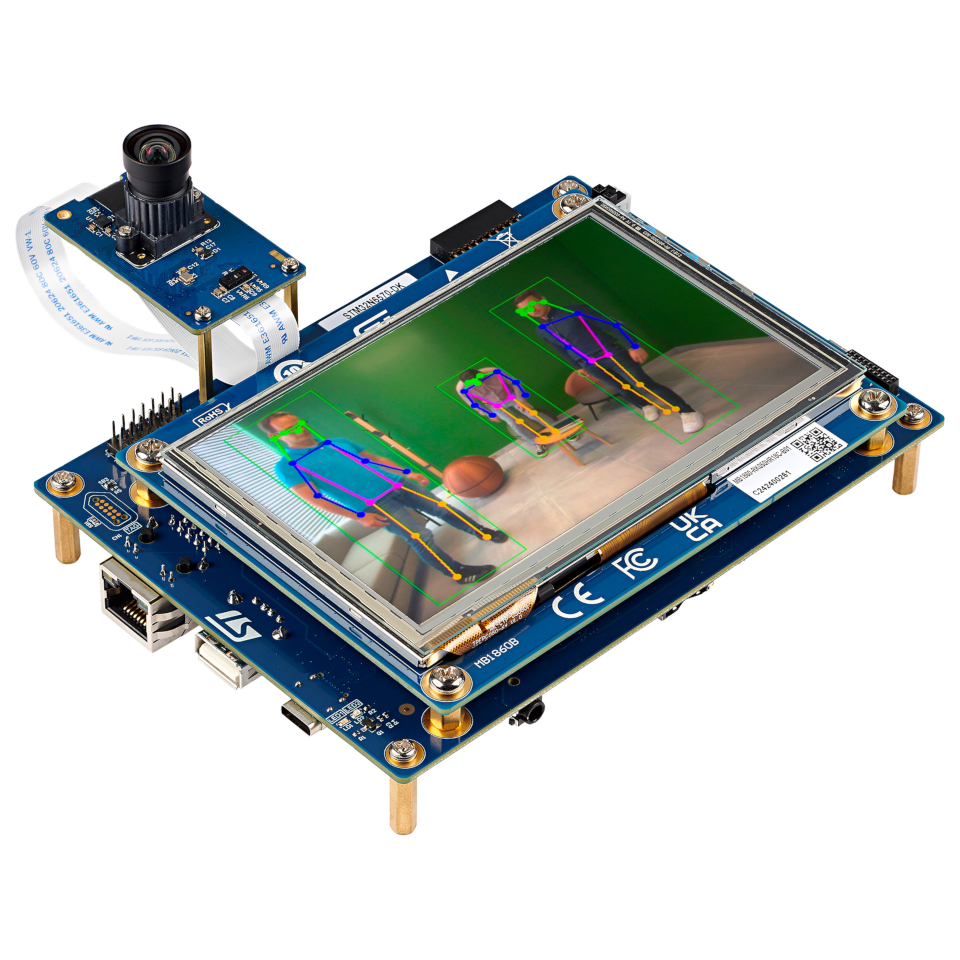
The STM32N6 represents a significant shift in STMicroelectronics’ MCU lineup. It is ST’s first implementation of the Arm Cortex-M55 core, but more significantly, it introduces a dedicated NPU, specifically STMs’ custom Neural-ART Accelerator, alongside MIPI-CSI, a 5 MP ISP, and a H.264 hardware encoder (VENC). At the time of release, this makes it one of only two MCUs with a native H.264 encoder. To top it of, it integrates a STM Neo-Chrome 2.5D GPU, a USB High-Speed (480 Mbps) controller and PHY, and a 1-Gbit Ethernet interface.
This huge variety of peripherals and hardware accelerators makes the STM32N6 one of the most versatile MCUs on the market right now. The core itself runs at up to 800 MHz, reaching 1280 DMIPS and a 3360 CoreMark score. while the NPU runs at up to 1 GHz to provide 600 GOPS at an efficiency of 3 TOPS/W. To feed both the NPU and VENC pipelines, a massive internal SRAM of 4.2 MByte is embedded, expandable externally through FMC or XSPI/HyperBus interfaces.
The downside of this complex MCU is that it is flashless, requiring an external flash for the firmware. Additionally, managing this volume of complex peripherals alongside the security extensions (TrustZone, secure IO, and isolated memory access) introduced by the Cortex-M55 makes bare-metal system initialization no easy feat.
This page serves as a “Living Notebook” for implementation details, gotchas, and lessons learned while implementing bare-metal peripheral drivers for the STM32N6. These insights were/are gathered during the development of the Instinct firmware for the PlumaN6 HD robot controller. This is not a in-depth tutorial series, but rather a collection of architectural traps, implementation details and gotchas to take into account when developing for the STM32N6 and pushing it to its limits.
Power Domains
The increased complexity of the STM32N6 starts with the power supply scheme. The MCU requires multiple independent supplies and some strict power-up sequencing. At a minimum, three different rails are required:
- VDDA18AON (1.8 V): Supplies the core analog blocks, oscillators, and power management. This is an “Always-On” rail and must be provided first.
- VDD (3.3 V or 1.8 V): Supplies the standard I/Os.
- VDDCORE (typically 0.8 V): Powers the internal functional logic (e.g. the CPU core). This can be generated by the integrated SMPS or provided externally.
Furthermore, some peripherals (such as USB, CSI, ADC, and the PLLs) have dedicated supply pins that can be tied to one of these three main supplies.
To support high-speed interfaces without external level shifters, the STM32N6 features dedicated, independent supplies for specific I/O banks:
- XSPI/HyperBus: Powered by VDDIO2 (pins PO[5:0] and PP[15:0]) for XSPIM1, and VDDIO3 (pins PN[12:0]) for XSPIM2.
- SDMMC: Powered by VDDIO4 (pins PC[1], PC[12:6] and PH[9,2]) for SDMMC1, and VDDIO5 (pins PC[0], PC[5:2] and PE[4]) for SDMMC2.
It is important to note that to use these dedicated IO voltage supplies, the peripheral signals must be routed to their primary IO pins! If you route an SDMMC signal to an alternate pin (e.g., mapping D0 to a pin outside the VDDIO4/5 groups), that pin will be driven by the main VDD rail instead.
Below is a block diagram of the supply scheme used to power the STM32N6 MCU in the PlumaN6 HD board:
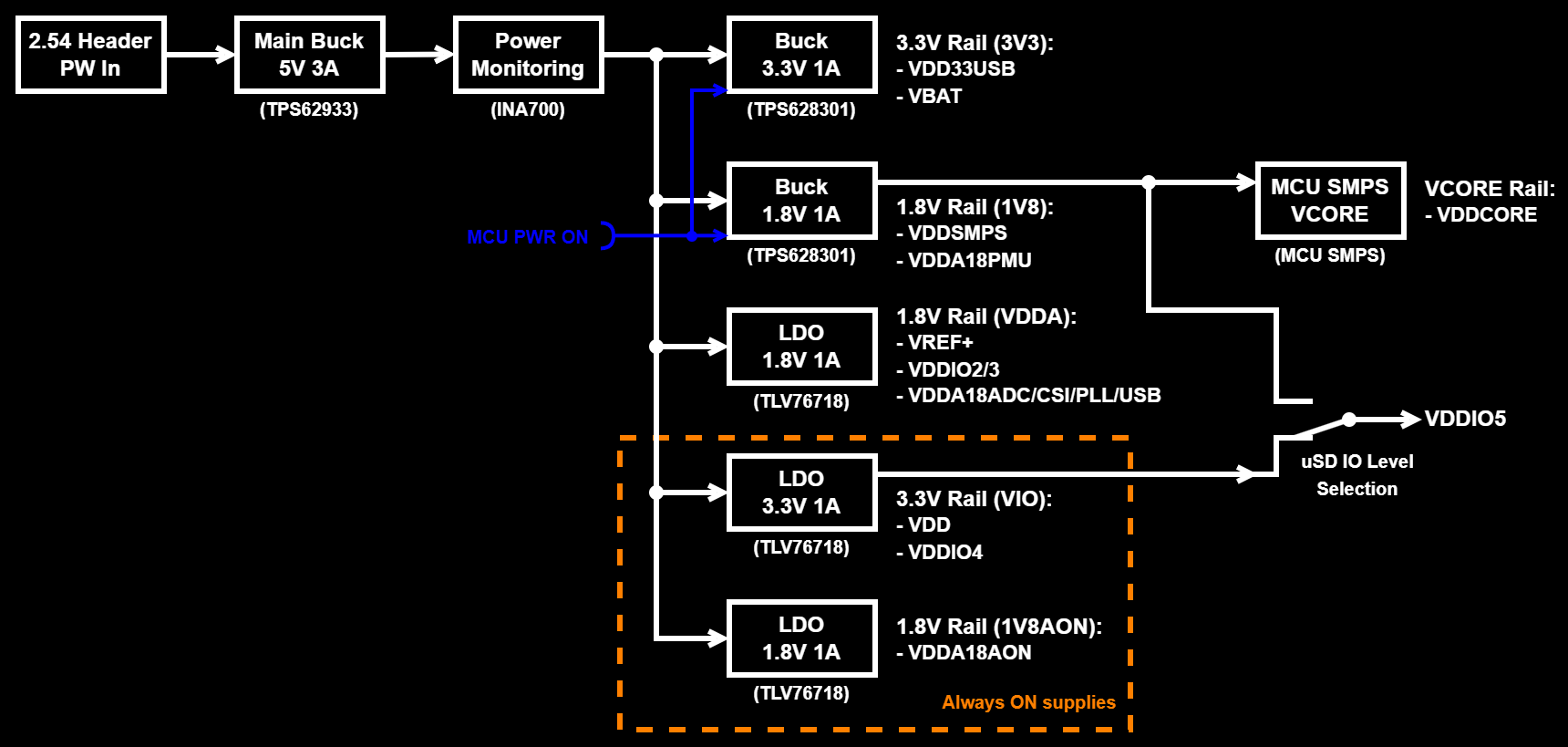
In this scheme, VDDCORE is generated by the integrated SMPS, which itself is powered by a 1.8 V rail. The VDD, VBAT, and VDD18AON rails are powered by always-on LDOs, while the remaining supplies are connected to supplies with their EN controlled by the MCUs Power-On signal. The non-dedicated IOs are powered by a 3.3 V rail. The dedicated IO supplies for the XSPI/HyperBus (VDDIO2 and VDDIO3) are powered by a 1.8 V rail, while the SDMMC interface to the uSD card uses a dynamic supply switch to toggle between 3.3 V (for initialization) and 1.8 V (for UHF-I speeds).
Clocks & PLLs
The clock tree of the STM32N6 is also significantly more complex and configurable than previous STM32 families. It keeps the multiple clock sources and oscillators (HSE, HSI, MSI, LSE, LSI) but expands the clock tree with 4 independent PLLs (PLL1 to PLL4) and 20 distinct clock dividers (IC1 to IC20). These ICx dividers take a PLL output and scale it down for specific domains:
- IC1: CPU core clock (SYSA)
- IC2: AXI, AHB, and APBx buses (SYSB)
- IC6: Neural-ART NPU clock (SYSC)
- IC11: Tightly coupled NPU SRAM (AXISRAM3/4/5/6 via SYSD)
The remaining dividers are used for peripheral groups (e.g., all I2Cs or all UARTs share a divider). There are although some nuances here, and which are “hidden” in the STM32CubeMX configuration. For instance, the CSI-PHY clock is IC18, which must be manually enabled and set to a maximum of 27 MHz.
An interesting challenge is running all high-speed cores at their respective maximum clocks. This is, the MCU core at 800 Mhz, the NPU core at 1000 MHz, and the NPU SRAM (AXISRAM3/4/5/6) at 900 MHz. Because there is no low enough common multiple between these frequencies, they cannot be derived from a single PLL. On the PlumaN6, this is solved by dedicating a PLL to each major domain:
- MCU Core: PLL1 (VCO at 3200 MHz, divided by 4 = 800 MHz)
- NPU Core: PLL2 (VCO at 3000 MHz, divided by 3 = 1000 MHz)
- NPU SRAM: PLL3 (VCO at 2700 MHz, divided by 3 = 900 MHz)
Although this might come with performance penalties for data crossing different clock domains/speeds, this has not been evaluated yet. The complete implementation for this clock configuration can be found in the Instinct firmware repository here.
Boot & Security
Due to the enhanced hardware security architecture and the flashless design, the boot process of the STM32N6 is more complex then from earlier STM32 families. As of now, this section will only explore non-secure boot modes. The STM32N6 has a small BootROM holding the factory bootloader. At reset, the BootROM samples the boot selection pins and reads internal OTP fuses (in the BSEC block) to determine which boot mode to enter. The boot configuration relies on two pins:
- BOOT0 (Dedicated pin): Selects between Serial Boot (‘1’ or VDDIO) and External Memory Boot (‘0’ or GND).
- BOOT1 (Non-dedicated pin): By default mapped to PA6. It can be permanently re-assigned ONCE via OTP19/BOOTROM_CONFIG_10. It selects between Development Boot Mode (‘1’ or VDDIO) or other (‘0’ or GND).
An essential, but annoying, security behavior of the STM32N6 is that the debug access port (SWD/JTAG) is closed by default at reset, unless the MCU boots into Development Boot Mode (BOOT1=1). In all other boot modes (including standard External Flash boot), the firmware must explicitly open the debug access port via the Security and Configuration block (BSEC):
LL_APB4_GRP2_EnableClock(LL_APB4_GRP2_PERIPH_BSEC);
BSEC->AP_UNLOCK = 0xB4;
BSEC->DBGCR = 0xB451B400;
Development Boot Mode (BOOT1=1, BOOT0=Any)
This is the primary mode used during development. The BootROM is halted, and the debugger interface is completely open from power-on, providing full access to internal registers, OTP areas, and memory buses.
In this mode, firmware can be downloaded via SWD/JTAG directly into AXISRAM2 (512 kBytes, starting at 0x34180000). This memory region serves both for code and data memory, so the memory must be partitioned in the linker script (e.g. 256K for .text and 256K for .data/.bss/stack). No external flash loader or other flashing utilities required, essentially in this modes the MCU works as any other MCU with internal flash only that the firmware is volatile (lost after a reset).
Serial Boot Mode (BOOT1=0, BOOT0=1)
Serial Boot Mode is used for simply dumping code into the AXISRAM2. The debugger remains locked in this mode. The BootROM scans the following interfaces for incoming connections:
- USB OTG1 (DFU)
- USART1: RX on PE6, TX on PE5
- USART2: RX on PF6, TX on PA5
- USART4: RX on PA1, TX on PA0
Serial interfaces can be individually restricted or disabled permanently via OTP configuration bits (OTP11/BOOTROM_CONFIG_2[16:9] OTP11/BOOTROM_CONFIG_2[22:20]).
This is typically used to update the FSBL in production, but requires that the flashed FSBL is self-flashing i.e. that after loaded into AXISRAM2 with the serial interface, it copies itself into the external flash so that it runs after a reboot (and boot mode switch). It also provides a very important recovery mechanism, it can be used to flash firmware even if BOOT1 is damaged and development boot mode is not available i.e. the traditional external loader flashing is not possible. This happened during the PlumaN6 development and led to the development of a self-flashing FSBL (Code: here).
To flash this into AXISRAM2 using USB DFU mode, the following commands are used:
C:\ST\STM32CubeProgrammer\bin\STM32_Programmer_CLI.exe -c port=usb1 -d "Firmware_Signed.bin" 0x01 -v
C:\ST\STM32CubeProgrammer\bin\STM32_Programmer_CLI.exe -c port=usb1 -detach
The -detach command is mandatory so that the BootROM actually starts executing the loaded binary.
During development, and when using Visual Code as the IDE, this can be automated to allow loading the firmware to the AXISRAM2, running it, and connecting with a debugger in hot-plug mode. Giving a mostly similar experience as Development Boot Mode. For this, a preLaunchTask is added to the launch.json that triggers a task in tasks.json that executes the USB DFU download. Also, important that the debugger connects in hot-plug mode ("-m", "1" in serverArgs and serverReset: "None"), with NO reset or image download after flashing. Since execution starts immediately after detach, the firmware must enable the debug interface and can then wait in main() for the debugger connection:
// ...

// Enable debug interface in firmware
LL_APB4_GRP2_EnableClock(LL_APB4_GRP2_PERIPH_BSEC);
BSEC->AP_UNLOCK = 0xB4;
BSEC->DBGCR = 0xB451B400;

// ...

// Wait for debugger connection (Hot-Plug mode)
while ((CoreDebug->DHCSR & CoreDebug_DHCSR_C_DEBUGEN_Msk) == 0) { __NOP(); }

// ...
External Memory Boot Mode (BOOT1=0, BOOT0=0)
This is the standard operational mode. The BootROM initializes the selected external storage peripheral, verifies the signed container, copies the payload into AXISRAM2, and jumps to it.
This firmware must be signed using STMs signing utility (STM32_SigningTool_CLI.exe, part of STM32CubeProgrammer) adding a special 1 KByte header. The BootROM verifies this header to check if a valid firmware is present, if not the BootROM fails back to Serial Boot Mode.
Because the BootROM loads the firmware into AXISRAM2 (firmware starting at 0x34180400, header starting at 0x34180000), same as in Development Boot Mode, this firmware must fully fit in this memory region of 512 KBytes. To accommodate the larger firmware, the boot process becomes a multi stage process where first a simple firmware is loaded by the BootROM, called the FSBL. The FSBL then initializes the system, turns on external PSRAM/SDRAM, sets up memory-mapped XIP (eXecute-In-Place) or copies the main application into other SRAM banks or PSRAM, and executes the jump. Important to NOT confuse the BootROM that is static in the STM32N6 ROM and the FSBL which must be created and flashed to external memory by the user.
For the BootROM to know how to load the FSBL, the type of external memory used must be defined using OTP bits OTP11/BOOTROM_CONFIG_2[8:5]:
- BOOTROM_CONFIG_2[8:5]=0x0 or ‘0000’ (Boot Config. 6, default): NOR device connected to XSPIM_P2
- BOOTROM_CONFIG_2[8:5]=0x1 or ‘0001’ (Boot Config. 2): SD device connected to SDMMC1
- BOOTROM_CONFIG_2[8:5]=0x2 or ‘0010’ (Boot Config. 4): eMMC device connected to SDMMC1
- BOOTROM_CONFIG_2[8:5]=0x3 or ‘0011’ (Boot Config. 6): NOR device connected to XSPIM_P2
- BOOTROM_CONFIG_2[8:5]=0x5 or ‘0101’ (Boot Config. 7): HyperFlash device connected to XSPIM_P2
- BOOTROM_CONFIG_2[8:5]=0x7 or ‘0111’ (Boot Config. 3): SD device connected to SDMMC2
- BOOTROM_CONFIG_2[8:5]=0x8 or ‘1000’ (Boot Config. 5): eMMC device connected to SDMMC2
Important to note that when using XSPI/HyperBus memories for booting, the BootROM only support XSPI Port 2 (XSPIM_P2). Also, if the debugger is not specifically enabled by the FSBL (or any user firmware) it will NOT be able to connect to the MCU contrary to the Development Boot Mode.
Below is an example code snipped of the FSBL part that is responsible to jump from the FSBL to the application running in XIP mode from XSPI2:
#define FW_HEADER_OFFSET						0x400
#define FW_IMAGE_OFFSET							0x00100000

typedef void (*pFunction)(void);
static pFunction JumpToApp;

uint32_t appVector = 0x70000000UL;	// XSPI/HyperBus 2 base address
appVector += FW_IMAGE_OFFSET + FW_HEADER_OFFSET;

// Initialize application's Stack Pointer and Jump to user application
uint32_t primaskBit = __get_PRIMASK();
__disable_irq();

// Clear all pending interrupt requests in NVIC
for(uint32_t irqIndex = 0; irqIndex < 8; irqIndex++) {
	NVIC->ICER[irqIndex] = 0xFFFFFFFF;
	NVIC->ICPR[irqIndex] = 0xFFFFFFFF;
}

SCB->VTOR = (uint32_t)appVector;
JumpToApp = (pFunction)(*(__IO uint32_t *)(appVector + 4u));

// On ARM v8m, set MSPLIM before setting MSP to avoid unwanted stack overflow faults
__set_MSPLIM(0x00000000);
__set_MSP(*(__IO uint32_t *)appVector);

// Re-enable the interrupts
__set_PRIMASK(primaskBit);

JumpToApp();
Flashing Firmware to External Memory
To flash a firmware to the external memory, the simplest way is to use the STM32CubeProgrammer with a custom External Loader (.stldr). This is a minimal standalone ELF executable that STM32CubeProgrammer loads into AXISRAM2 over the debug port (requiring Development Boot Mode). The loader code must implement a standard API, a set of functions that the STM32CubeProgrammer can call up to flash code to the external flash:
__attribute__((used)) uint32_t Init();
__attribute__((used)) uint32_t Write(uint32_t Address, uint32_t Size, uint8_t* buffer);
__attribute__((used)) uint32_t SectorErase(uint32_t EraseStartAddress, uint32_t EraseEndAddress);
__attribute__((used)) uint64_t Verify(uint32_t MemoryAddr, uint32_t RAMBufferAddr, uint32_t Size, uint32_t missalignement);
__attribute__((used)) uint32_t MassErase(uint32_t Parallelism);
The loader must also define a StorageInfo struct that details memory geometries and base offsets to the programmer:
#define MCU_FLASH		1
#define NAND_FLASH		2
#define NOR_FLASH		3
#define SRAM			4
#define PSRAM			5
#define PC_CARD			6
#define SPI_FLASH		7
#define I2C_FLASH		8
#define SDRAM			9
#define I2C_EEPROM		10

typedef struct {
	unsigned long SectorNum;			// Number of Sectors
	unsigned long SectorSize;			// Sector Size in Bytes
} DeviceSectors;

typedef struct {
	char DeviceName[100];				// Device Name and Description
	unsigned short DeviceType;			// Device Type: ONCHIP, EXT8BIT, EXT16BIT, ...
	unsigned long DeviceStartAddress;	// Default Device Start Address
	unsigned long DeviceSize;			// Total Size of Device
	unsigned long PageSize;				// Programming Page Size
	unsigned char EraseValue;			// Content of Erased Memory
	DeviceSectors sectors[2];
} sStorageInfo;

// Definition for 64MB HyperFlash on the PlumaN6 HD (connected to XSPI2)
__attribute__((used)) sStorageInfo const StorageInfo = {
	"26HS512TA100_PlumaN6HD",		// Device Name + Board name
	NOR_FLASH,						// Device Type
	0x70000000UL,					// Device Start Address (For XSPI2)
	0x4000000,						// Device Size in 64 MBytes
	0x0200,							// Programming Page Size 512 Bytes
	0xFF,							// Initial Content of Erased Memory
	{
		{0x00000100, 0x00040000},	// Sector Num: 256, Sector Size: 256 KBytes
		{0x00000000, 0x00000000}
	},
};
All these code snippets are from the PlumaN6 Instinct Firmware and can be found here.
One of the most radical architectural changes in the new STM32N6 series is that it is entirely flashless, requiring external flash memory to store and execute firmware. To support this, the MCU features a highly versatile set of memory interfaces including a parallel FMC (Flexible Memory Controller), two high-performance XSPI (Extended Serial Peripheral Interface) ports compatible with up to 16-bit wide HyperBus protocols, and dual SDMMC interfaces.
These interfaces are also available in other STM32 MCU series but are crucial in the STM32N6, not just for the firmware, but for expanding the RAM buffers for the NPU and video pipeline. To get the maximum performance out of the Cortex-M55 core, NPU, and video stack, the highest bandwidth interface must be used. At first glance, one might assume that this is the parallel FMC, but this is not the case. The highest bandwidth interface available is the XSPI running in a 16-bit wide HyperBus configuration. It reaches a theoretical throughput of 800 MByte/s (200 MHz clock, 16-bit wide, double data rate) compared to the 664 MBytes/s of the parallel FMC (166 MHz clock, 32-bit wide, single data rate). The STM32N6 provides two HyperBus compatible ports: one 16-bit wide and one 8-bit wide. On the PlumaN6 HD board, the 16-bit port is dedicated to external high-speed PSRAM, while the 8-bit port handles external Flash.
This section focuses on the direct-register implementation details and hardware-level gotchas encountered while building the HyperBus and SDMMC drivers.
Internal SRAM & Memory Map
To support the vision and NPU pipelines, the STM32N6 features a massive 4.2 MByte internal SRAM, made possible in part by the flashless design. Although this SRAM is contiguous in the address space, it is physically partitioned into multiple domains intended for specific bus masters and peripherals. For optimized use of this memory space, it is important to understand these partitions so that the “correct” memory regions are routed to the preferred peripherals. Below is a diagram showing the internal SRAM memory mapping (for the non-secure memory map):
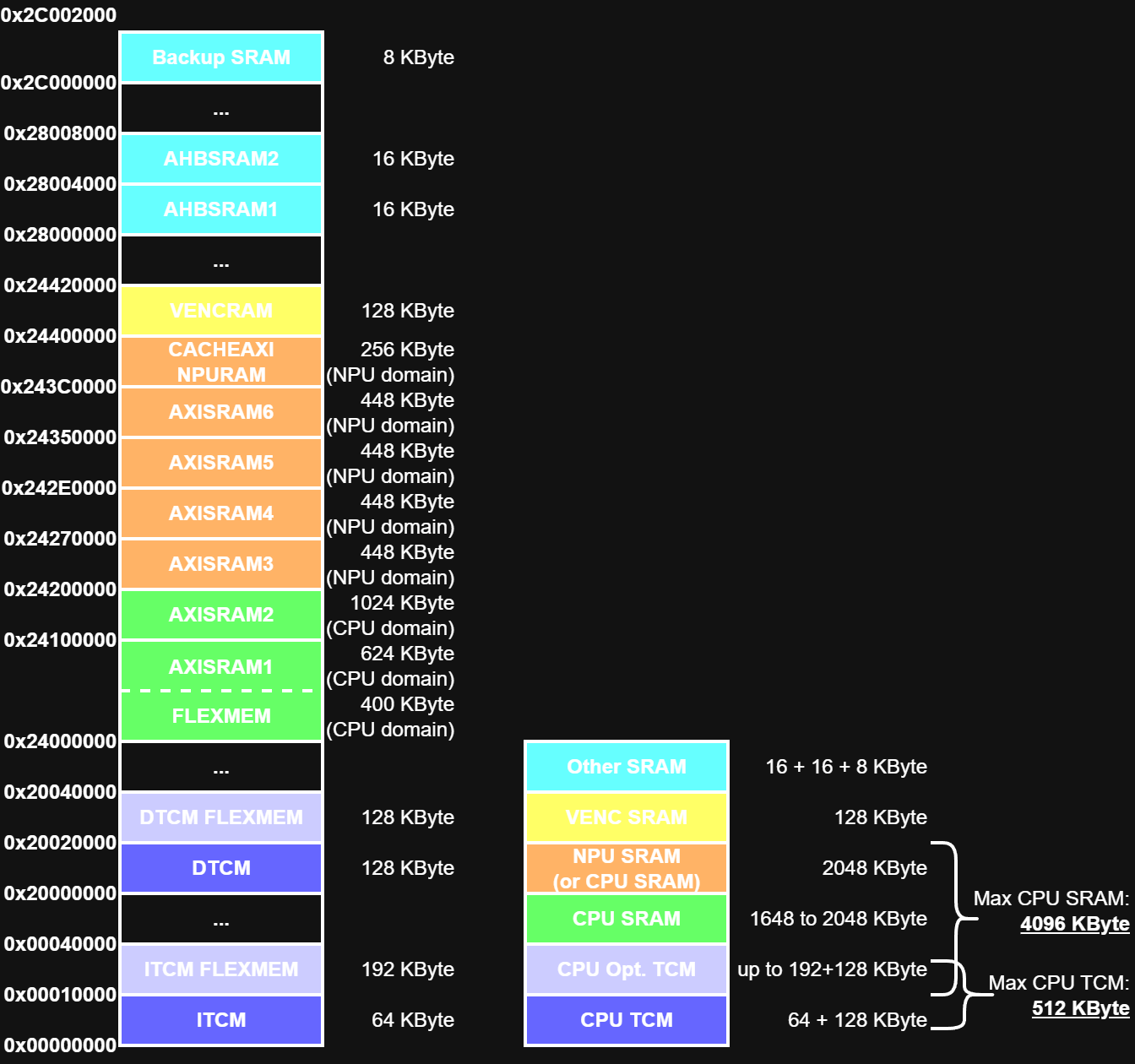
The SRAM is split into 5 main regions:
- Tightly-Coupled Memories (TCM): These are the I-TCM for instructions and D-TCM for data. These memory locations are closer to the CPU core and have significantly higher throughput and fewer wait-states when accessed by the CPU. They are intended for storing critical instructions/code and variables. Part of the TCM memory is programmatically allocatable: the 400 KBytes of FLEXMEM located in the lower part of AXISRAM1.
- General AXI SRAM (AXISRAM1 & 2): General-purpose system RAM accessible via the main AXI interconnect. This is the normal memory region where variables are placed if no specific memory location is set. It is also the ideal location for peripheral DMA buffers (e.g., SDMMC, USB, MIPI, etc…).
- NPU AXI SRAM (AXISRAM3 to 6): High-bandwidth SRAM banks tightly coupled to the Neural-ART NPU. These banks run on their own clock domain (via divider
IC11) to feed the NPU pipeline without saturating the main system bus. They can also be allocated as general-purpose system RAM. - VENCRAM: A dedicated SRAM domain specifically reserved for the VENC (H.264 video hardware encoder) peripheral for its internal operational use, NOT as a frame buffer. It can also be allocated as general-purpose system RAM if the VENC is unused.
- Others: Besides the above, there are a few smaller, more dedicated SRAM locations like the AHBSRAM1/2 connected to the AHB buses, and the backup SRAM that can be retained in stop mode.
Beyond the internal SRAM, the STM32N6 can map external memories directly into the Cortex-M55 address bus (memory-mapped mode). XSPI1 (typically used for external PSRAM) is mapped to 0x90000000, XSPI2 (typically used for external Flash) is mapped to 0x70000000, and XSPI3 is mapped to 0x80000000.
HyperBus
The XSPI peripheral operating in HyperBus protocol mode is relatively straightforward to initialize, even though it is one of the few peripherals that lacks an LL driver abstraction from ST. Because ST only provides a HAL implementation, you have to extract the raw register configurations manually. The essential register steps match previous STM32 families, but a few things require close attention:
- Symmetric Clocking: The clock prescaler register value should be an odd number to achieve an even division factor, ensuring a symmetric duty cycle clock signal.
- Minimum Access Granularity: Read and write transactions depend on bus width. On an 8-bit HyperBus, the minimum access is 16-bit; on a 16-bit bus, it is 32-bit. This is especially important when modifying internal registers of external devices.
- Byte vs Word Addressing: The STM32N6 XSPI peripheral handles addressing at the byte level. However, most external HyperBus devices expect word-aligned addressing. The driver must handle this conversion.
- Latency Restrictions: When operating in 16-bit HyperBus mode, the STM32N6 does not support variable latency configurations. Both the peripheral and the external device must be configured to fixed latency.
When using HyperBus memory areas via DMA rather than memory-mapped mode, standard cache coherency rules apply: invalidate the D-Cache before a read and clean (flush) the D-Cache after a write. Finally, due to the Resource Isolation Framework (RIF) security architecture on the Cortex-M55, the memory region’s security privileges must be configured before other peripherals or DMA channels can access the XSPI space. This is handled by setting up the RISAF registers (RISAF11 for XSPI1 and RISAF12 for XSPI2). To open up full read/write access to all device groups (CIDs) across the entire memory space in a non-secure bare-metal setup, the RISAF can be set with:
const uint32_t RIF_CID = 0x0F;
const uint32_t RIF_ATTRIBUTE_SEC = 0x00000001U;
const uint32_t RIF_CID_NONE = 0x00000000U;

RISAF11->REG[0].STARTR = 0x0;
RISAF11->REG[0].ENDR = 0xFFFFFFFFU;
RISAF11->REG[0].CIDCFGR = (RIF_CID | (RIF_CID << RISAF_REGx_CIDCFGR_WRENC0_Pos));
RISAF11->REG[0].CFGR = (RISAF_REGx_CFGR_BREN | (RIF_ATTRIBUTE_SEC << RISAF_REGx_CFGR_SEC_Pos) | (RIF_CID_NONE << RISAF_REGx_CFGR_PRIVC0_Pos));
The 1.8V HSLV OTP Trap: On the hardware side, HyperBus interfaces runs at 1.8 V and generally requires a differential clock. On the Rev. A PlumaN6 hardware a single-ended clock configuration was used as it is supported by the used external memories. Initially, I assumed this I assumed this single-ended routing was the reason for bit errors past 75 MHz and not being able to reach the maximum 200 MHz rate.
It turns out, the actual limitation was completely different, it was the HSLV OTP fuses. To operate the VDDIOs domains at high speed and 1.8 V, it is absolutely essential to program the One-Time Programmable (OTP) registers! Specifically, bits 15 (HSLV_VDDIO3) and 16 (HSLV_VDDIO2) of OTP124 must be set to 1 (see this ST community post). I used the STM32CubeProgrammer to set the bits but it can also be done in firmware. WARNING: These are one-time programmable fuses! Once set, the corresponding IO pins can never exceed 2.5 V, risking permanently damaging the MCU!
Crucially, programming the voltage level in firmware through register “SVMCR3” with bits “PWR_SVMCR3_VDDIO2SV” (or “PWR_SVMCR3_VDDIO3SV”) and “PWR_SVMCR3_VDDIO2VRSEL” (or “PWR_SVMCR3_VDDIO3VRSEL”), is not enough without setting also the OTP fuses, which I learned the slow and hard way… Tuning the drive strength registers on the external device proved to be beneficial, especially before setting the OTP fuses correctly.
The complete implementation for this clock configuration can be found in the Instinct firmware repository here.
External RAM (HyperRAM)
For the used HyperRAM in the PlumaN6 (S80KS2564) there where no real challenges in getting it working after having the HyperBus driver implemented. Only two details remained:
- Fixed Latency Enforcement: Due to the 16-bit bus constraints of the STM32N6, fixed latency mode had to be enforced.
- Address Translation: The internal configuration register addresses specified in the S80KS2564 datasheet are word-aligned. Because the XSPI peripheral operates on byte boundaries, these register addresses must be bit-shifted left by 2 to get the required byte addresses over the 16-bit bus.
Finally, I saw some read/write reliability improvement by tuning/adjusting the drive strength (in register CR0 bits [14:12]), this when using the (wrong) single ended clock mode.
The complete implementation for this clock configuration can be found in the Instinct firmware repository here.
External Flash (HyperFlash)
The story is repeated for the HyperFlash (S26HS512T), but this time the register addresses must be shifted by only 1 due to the 8-bit bus width. However, write operations for the HyperFlash device have some strict limitations:
- No Memory-Mapped Writes: Memory-mapped mode it is strictly read-only, due to being multi-cycle command operations.
- No Burst Programming: The S26HS512T does not support arbitrary burst writes. Every word must be committed individually with its associated addresses.
- Write Latency Bottlenecks: Flash programming is multiple orders of magnitude slower than reading. I tested a peak write rate of under 1 MByte/s due to sector programming overhead of the S26HS512T (around 2000 $\mu$s).
The complete implementation for this clock configuration can be found in the Instinct firmware repository here.
SDMMC (SD Cards)
High-speed storage is essential on the STM32N6, both for logging high-frequency telemetry and for loading massive assets like Neural Network weights and video files. The STM32N6 features dual SDMMC interfaces, with their own internal DMA (IDMA). Although in this case STM provides some low-level abstraction with a LL for SDMMC, my driver uses direct register access just as with the HyperBus. This peripheral is also quite simple, the SD card specific complex protocol is handled at a higher firmware level, but there are some things require close attention.
As mentioned, the SDMMC peripheral features its own DMA master interface, known as IDMA. Because it is a standalone bus master, it is subject to the same architectural limitations as other DMA controllers, meaning it cannot access all memory regions on the chip:
- The DTCM is not accessible. Trying to pass a buffer located on the stack (typically located in the DTCM) will result erroneous transactions.
- As with all DMA transfers, also here cache coherency must be handled correctly(cleaning before writes, invalidating after reads). Buffers must be be aligned to the cache line size (32 bytes) which can be enforced with “attribute((aligned(32))”) or “alignas(32)”. If a buffer is not cache-line aligned, your clean/invalidate operations will overlap with neighboring variables, silently wiping or corrupting unintended memory regions.
- Just like the HyperBus interface, the memory region’s security privileges must be configured for the IDMA AXI master to access required memory spaces. But here this is done through the RIMU (for non-RIF-aware peripherals), with master index 2 for SDMMC1 (“RIFSC->RIMC_ATTRx[2]”) and index 3 for SDMMC2 ("(“RIFSC->RIMC_ATTRx[3]”)").
When interfacing with SD/uSD cards there are some additional details to keep in mind (SD card specs: https://www.sdcard.org/downloads/pls/):
- Older Standard Capacity (SDSC) cards use raw byte addressing, while High Capacity (SDHC, SDXC, SDUC) cards use block addressing, where every block is 512 bytes. The driver must detect the card type and adjust the addressing accordingly.
- An SD card’s throughput is heavily limited by its internal flash page programming time. Not writing a complete sector, or aligned multiple sectors, leads to a large drop in write performance as the programming to flash time is identical for a whole or partial sector.
- For data rates above High Speed SDR (50 MHz), such as UHS-I modes, the IO voltage must be negotiated and switched from 3.3 V to 1.8 V. Either through level shifter or by changing the SDMMC IO voltage supply on the STM32N6 if all the used SDMMC IO are on the correct VDDIO domain (no alternative pin mapping!). Additionally, these modes require a tuning step.
The complete bare-metal implementations for the peripheral and protocol drivers can be found in the Instinct repository:
FileX Integration
To provide a FAT filesystem over the raw SD block driver, Instinct uses Eclipse FileX. Porting FileX to custom hardware and custom drivers also has a few important details:
- The memory pool buffer passed to “sd_media_memory” must be cache-aligned and located in an IDMA accessible memory region (not DTCM!).
- If the FileX scratch buffer and cluster sizes are set too small, format or erase operations will take forever. This happens because FileX ends up issuing a huge number of tiny erase block commands. Always set appropriate, large sizes (e.g., a 64 KB scratch buffer and 32 KB clusters).
- FileX Format Catch-22: Attempting to open an unformatted SD card using “fx_media_open”, the function will naturally fail. However, upon failing, FileX internally sends an UNINIT command that erases all cached SD card information from the FileX media structure. A following formatting by calling “fx_media_format” will fail because FileX no longer knows the size of the disk! Solution is to force write (inject) the capacity information before explicitly calling the (custom) SD card driver functions (like “Init” and “GetBlockCount”) to repopulate the structure before calling “fx_media_format”.
- Hidden Sector Offset: Windows formatted SD cards do not place the FAT filesystem at Sector 0. Sector 0 contains the Master Boot Record (MBR), with the actual FAT filesystem typically starting 8192 sectors later (known as hidden sectors). This needs to be taken into account when setting up the media in FileX and when reading the file system (“sector 0”).
The complete FileX port for the ThreadX/FileX stack to the bare-metal SD driver can be found here.
Section under development with content to come!
Section under development with content to come!
Section under development with content to come!